SHE

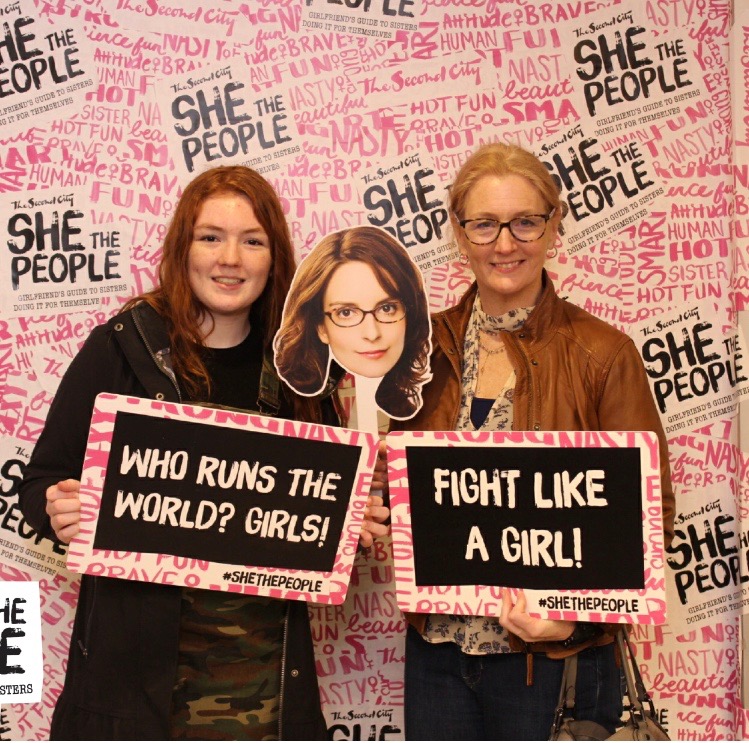
For my fourth and final SAMO of the year I went to see She The People at Second City with my Mom. On March 29 me and my Mom drove down to the city to spend the night there. On the way we decided it would be a good time to get a SAMO done so we got tickets to see “She the People” at Second City.  I had heard about the show from other people in other CST classes and they recommended the show as a great SAMO, so I decided to try it out. My mom and I were both unsure what to expect going to see the show so we looked it up and the description on their website describes the show as “She The People – a sketch show entirely created, designed, and performed by the fearlessly funny women of The Second City! This mimosa-and-madness-fueled foray roasts the patriarchy, taking on everything from having it all…to having that sick feeling your government is trying to send you back to the Middle Ages.” After reading the description of the show I was still really excited to go although I wouldn’t consider myself a very outspoken feminist. When we got to Second City my mom and I took pictures with different signs in front of a She the People wall.
IMG_8081
Me and my Mom

 I had been to second city to see a show before but it was a much smaller show than She the People. When we got our seats I looked around and noticed the audience was filled mainly with middle aged women. I didn’t really see anyone my age. I got a little nervous because I was worried the show wouldn’t make sense to me or I’d get lost in the humor but my once the show started I understood a lot of the topics that were discussed. Even if I was unfamiliar with a topic being discussed I found myself learning more about it the more the all women cast talked about it. It was eye opening to witness the show and understand the topics they were joking about. A topic they talked about a lot was the expectations women face with looking beautiful or fitting the stereotypical definition of beauty.
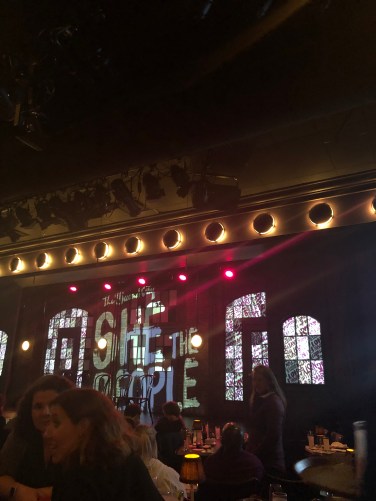
IMG_8079
The stage from where we sat

In the Cycle of Socialization by Bobbie Harro it says “What can I do to change it? It is a huge phenomenon, and my small efforts won’t count for much.” The women performing  She the People are doing what they can to show the struggles women still face daily. Even though doing a comedy show may seem like just a small effort in fighting for equality for women it starts a conversation and sends a message to everyone that sees the show. I thought the show was super relatable and they portrayed the message that being yourself is beautiful in such a funny way.  They also talked about other hard to talk about topics like race, the wage gap, and other stuff. After the show I felt like I’d learned a lot more about how women are treated in society today. Seeing the show also made me think about being a women in ways I’d never really thought of before. They talked about white privilege and they showed many of the challenges and stereotypes that come with being a black women that I’ll never experienced. It was eye opening to see because it showed me that being a women in today’s society can be tough but whether you’re a man or women or whatever if you’re white you inherently have white privilege. 


To Recap it all…  

What: She The People

Where: 1616 N Wells St, Chicago, IL  (Second City)

How did you get there: Was staying in the city so we took a taxi  

How much did it cost? It was $37 per ticket.

Would you recommend it to other CST learners?  Yes! It was such a fun thing to do in the city and was an entertaining SAMO

Refugee Blog 1

The UNHCR  defines being a refugee as “…someone who has been forced to flee his or her country because of persecution, war or violence. A refugee has a well-founded fear of persecution for reasons of race, religion, nationality, political opinion or membership in a particular social group. Most likely, they cannot return home or are afraid to do so. War and ethnic, tribal and religious violence are leading causes of refugees fleeing their countries.”  No one becomes a refugee by their own choosing. They’re a lot of times forced to leave their homes to save their lives. When they make it out of their home countries it’s not the end of the rough and dangerous journey ahead. Today 68.5 million individuals have been forcibly displaced worldwide as the result of many things like persecution, conflict, and human rights violations in their home countries.


A child stands in front of her home at a refugee camp in Dadaab, Kenya, Thursday, Aug 4, 2011. Dadaab, a camp designed for 90,000 people now houses around 440,000 refugees.

Not all these people are refugees though. Worldwide there are 25.4 million refugees, the highest number the worlds seen to date.  While not all refugees live in refugee camps roughly 2.6 million do! That’s more than the population of some states in America like Idaho, South Dakota, North Dakota, Maine, Vermont, West Virginia and more! Think about if you were one of those people right now and the things you’d bring with you, and where you would go when fleeing. For 2.6 million people there weren’t many options at all forcing them to turn to live in a refugee camp. With limited spaces in the camps and a seemingly never ending demand for more space many camps open up overflow areas that end up just as large as the main camps. While reading City of Thorns by Ben Rawlence I read from a perspective of different people living in the refugee camp. One of the main characters that stuck out to me what Guled. He first arrived at the camp at a young age and didn’t really know much about how things worked in the camp. “When he asked about work, Noor laughed. Guled learned that employment in Kenya was forbidden. Like many governments anxious about asylum seekers, Kenya didn’t want Somalis taking Kenyan jobs, so all formal work with a decent salary, with the agencies and the UN, was reserved for Kenyans”. I learned that the refugees in the camp struggled to find work and how hard it was for them to make a living. They were forced to work the “low-class” jobs or jobs throughout the camps. Everyone traveling to the camps were already in tough  places in their lives, many had little money or belongings left to their names. In the camps instead of always paying for things with money, people barter for items and try and trade things in the market. Life is lived so differently in refugee camps than many of us can ever relate to. Some refugees that don’t end up in camps apply to come to America and other countries. Even refugees that have lived in camps for years still apply to other countries to start a new life.


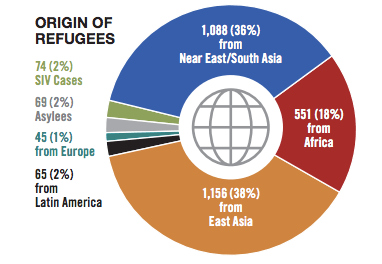
Origin of refugees in Illinois

The security vetting process that refugees need to go through when applying to come to America can take between 18-24 months to MAYBE get approved. In Illinois there is a refugee program known as “The refugee resettlement program”. Sense 1975 the program has resettled more than 126,000 refugees from 86 countries into Illinois. Illinois currently has about 3,048/70,000 refugees admitted into the United states living within the state. The Illinois program offers many services to help the refugees get started in America. They offer social work services, doctor services, mental health services, and many more that a majority of the refugees take advantage of.  A Majority of the refugees in Illinois originate from around East Asian and South Asian countries.   By looking online and contacting local organizations you can figure out how you can help local refugees and refugees around the world. 

Links to learn more:

https://www.unrefugees.org/refugee-facts/what-is-a-refugee/ 

http://www.chicagorefugee.org/refugee-services.html 


Pictures Speak

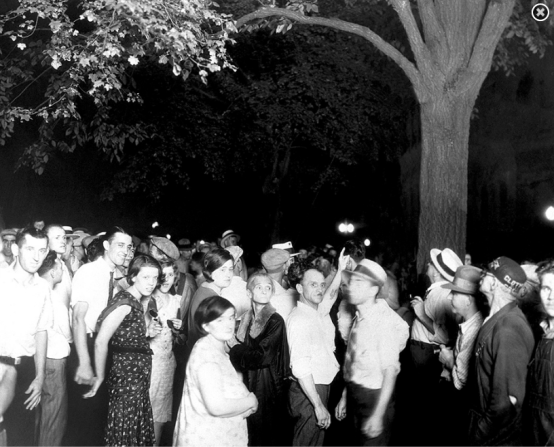
A picture does not move, does not talk, but it’s still conveying a loud message.  The popular saying “a picture says a thousand words” is used over and over again. It may be confusing because we all know pictures don’t really talk but the saying has a deeper meaning behind it. When you see a picture the first thoughts that come to your mind are just your initial observations but you don’t really grasp the entire image until you look for a while longer. Even the small aspects of a photo are important in telling the whole story. When first looking at this picture I see it’s black and white but when I look longer I realize that the picture is from many years ago. When diving into understanding a picture you should start with just what you see and go from there.   In Citizen by Claudia Rankine she uses pictures and blank space to convey just as loud a message that she conveys with her words. Looking at the picture below used on page 91 the first thing you probably think is it’s just an old picture of a group of people

Screen Shot 2019-04-25 at 11.08.17 AM

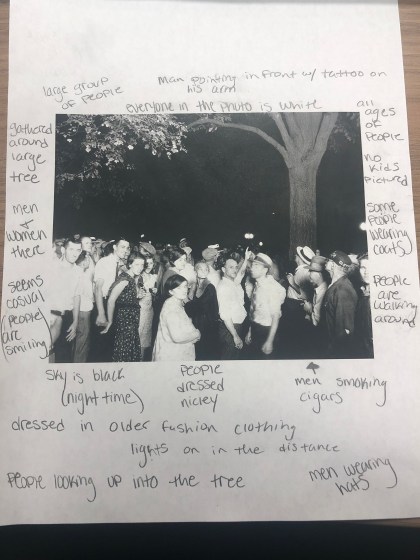
When you observe the picture for a while you begin to notice more and more about it. IMG_8201

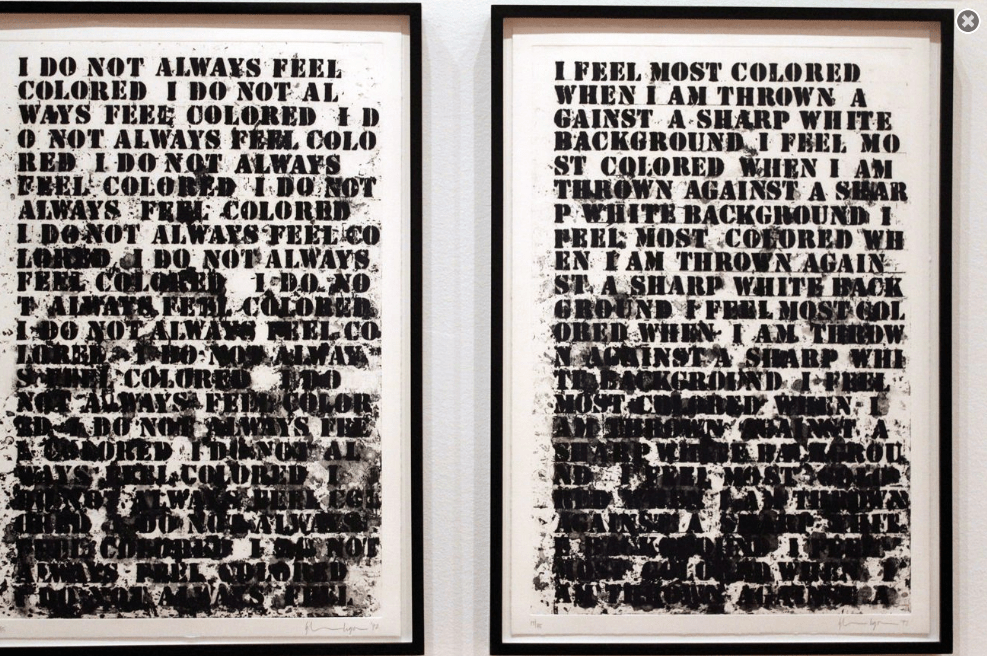
I wrote out everything I saw in the picture. It doesn’t matter if what you notice is something small because it all goes together to tell the bigger story of the image. When you look at the picture more you noticed peoples relaxed facial expressions and all aged people moving around the trees. I also noticed how it looks like the picture is missing something.  I looked up online the origins of the picture to learn more about it. I learned that the picture Claudia Rankine used in Citizen is actually an edited picture. The original picture features two African-American men hanging from the trees. The original photo taken in 1930 shows a lynching at the time segregation and racism was prevalent throughout America.  In Citizen it says “The past is a life sentence, a blunt instrument aimed at tomorrow.” You can never go back and change what happened in the past, but you should learn from it and let it affect your future. Another picture used in citizen to communicate without words, kind of uses words. The picture below on pages 52-53 of Citizen shows repeated words getting blurrier and more smudged the more you move down the page. 

Screen Shot 2019-04-25 at 11.11.01 AM

When first looking at this picture I was confused because I din’t know how repeating phrase ” I DO NOT ALWAYS FEEL COLORED” and “I FEEL THE MOST COLORED WHEN I AM THROWN AGAINST A SHARP WHITE BACKGROUND.” I again wrote down all of the things that I began to notice, the obvious stuff and the stuff that took me longer to notice.

IMG_8200

The farther down you read in the picture the more blurred the words get.  I interpreted that as the more people try to fight the stereotypes the harder it is to navigate for them. Race is such a hard topic to talk about and a lot of people don’t like talking about it. I Interpreted the picture as an art piece to represent the difficulty of discussing race.

SAMO 3


For my third SAMO of the year I went to the Chicago Cultural Center. While I was there I saw many different exhibits. At the Chicago Cultural Center they don’t just have one exhibit, they have many different traveling exhibits so the art displayed there changes periodically. On Wednesday March 13th me and my mom drove down to the city to visit the museum. It took us a little bit longer than expected to drive into the city because I got us lost, but after finding our way again we found the museum. Finding parking was easy for  us because we found a parking garage up the street but there is no designated parking for the museum. The Cultural Center and all the exhibits were free to go see you just walk in. One of the exhibit we walked through was Arts of Life. It was an exhibit featuring artwork made by adults with disabilities in a day program. I really enjoyed seeing the art in this exhibit because I don’t think I’ve ever seen an art exhibit exclusively featuring artists with disabilities. This reminded me of Willing to be Disturbed by Margaret Wheatley it says “We live in a dense and tangled global system. Because we live in different parts of this complexity, and because no two people are physically identical, we each experience life differently. It’s impossible for any two people to ever see things exactly the same.”  Although the artists have differences they don’t let that stop them from being artists.  The art was beautiful and very colorful.  

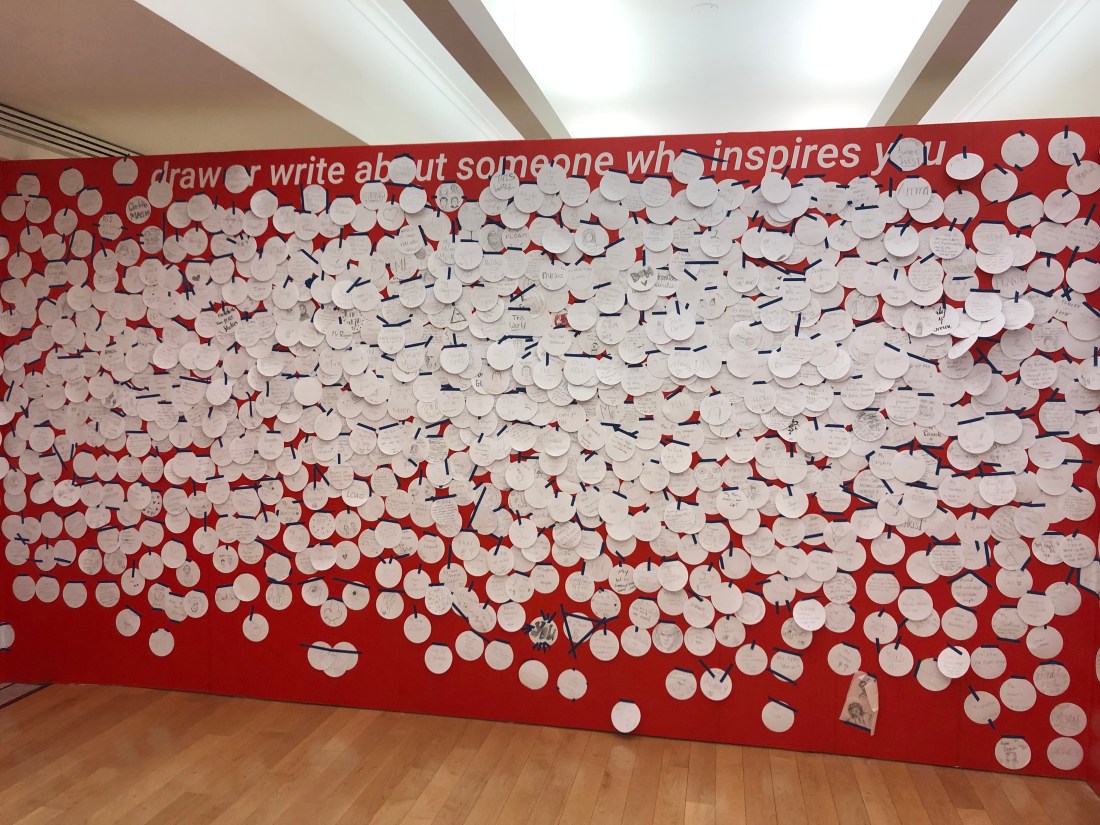
The exhibit also featured a wall that allowed people to write what inspires them. Although when I went there was no more room on the wall I got to read what inspires everyone else who had been there. People wrote about people that inspire them in their lives and the things that motivate them. It really made me think about the exhibit as a whole because although the artists have disabilities they don’t let that stop them and they find inspiration in things enough to make art.

IMG_7900
Here, people who visited the Arts of Life exhibit wrote what inspires them

 Another exhibit I saw while there was Bronzeville Echoes: Faces and Places of Chicago’s African American Music. They highlight great Chicago musicians that changed the music scene here. I learned so much about the history and influence of African American music in Chicago. Before jazz and blues music became popular Ragtime music was big, especially in Chicago. The exhibit highlighted Florence Mills. An African American singer and dancer became famous after coming to Chicago in 1916. In a time when not many women, let alone African American women, were making a name for themselves Florence Mills became an instant star. I had ever known about the rich history behind African American music in Chicago, the exhibit really taught me a lot. Today, no recordings of Florence Mills singing exist because none of her performances were ever recorded. Although she had major influence in the Harlem Renaissance her name is largely forgotten when thinking back to the artists that influenced jazz and ragtime music.

To Recap it all…

What: Chicago Cultural Center

Where:  78 E Washington St, Chicago, IL 

How did you get there:  Drove with my Mom

How much did it cost? It was FREE!

Would you recommend it to other CST learners?  Yes! It was such a cool experience seeing all the different exhibits the Chicago Cultural center had to offer

Mind and Body


IMG_7718
My mashboard

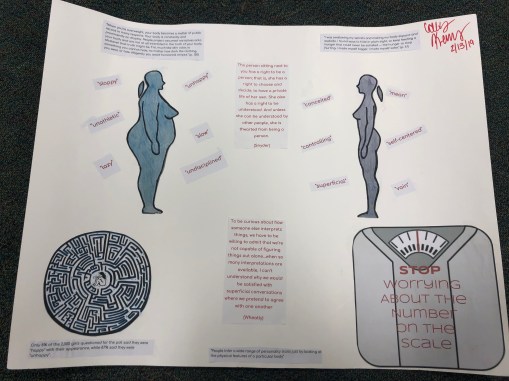
In the world we live in today there are countless numbers of stereotypes for everything, especially people’s physical attributes.  These stereotypes can really affect people’s feelings about themselves and their confidence. In my mashboard I wanted to show examples of those stereotypes and also the struggles people with body confidence issues go through everyday.

In the book Hunger by Roxane Gay she shares her sexual assault story along with how it affected her relationship with her body. I put quotes of hers from the book onto my mashboard explaining how she viewed the assumptions of her body. “When you’re overweight, your body becomes a matter of public record in many respects. Your body is constantly and prominently on display. People project assumed narratives onto your body and are not at all interested in the truth of your body, whatever that truth might be. Fat, much like skin color, is something you cannot hide, no matter how dark the clothing you wear, or how diligently you avoid horizontal stripes” (p. 120).  It’s really hard to hide your body from the world. It’s they’re for everyone to see. For Roxane and many other people the idea of going out into public and have people look at them and assume, based on their physical appearance, things about their work ethic, drive, and lifestyle is a stressful things.

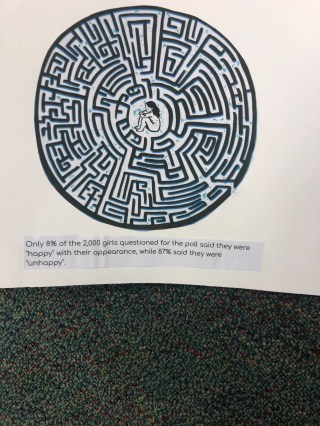
I chose to use the picture of a girl at the center of a maze to create dialogue around my mashboard. I thought that putting the picture on the mashboard would have people asking questions about what the deeper meaning of the picture is.  Many people struggle with body confidence issues. I think the image encapsulates the feeling perfectly. LIke a maze, the journey to find yourself can take a while and sometimes you go won’t be going the right way. But in the picture you can see the maze has many different routes to get to the center. Just like there are many different ways to find self love and security.

IMG_7721

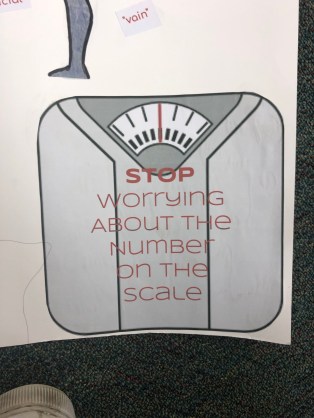
I also incorporated a scale on my mashboard. I made the scale with the message “STOP WORRYING ABOUT THE NUMBER ON THE SCALE”. I thought it was important to have something like this on my mashboard because peoples weight is a really sensitive topic for some people.  For many people, the more the scale numbers go up, the worse they feel about themselves. I wanted to really send the message that people shouldn’t obsess over things like weight just because they think they weigh more than they should.

IMG_7727

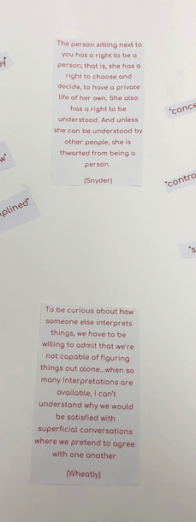
I decided to put two quotes in the center of my mashboard because I did not want to leave an empty space between the two bodies. I used these specific quotes because they I think they tie together the whole theme of the board. The top quote by Ross Snyder from The Person Sitting Next to You says “The person sitting next to you has a right to be a person; that is, she has a right to choose and decide, to have a private life of her own. She also has a right to be understood. And unless she can be understood by other people, she is thwarted from being a person”  (Snyder). It’s human nature to judge people based on first impressions. Anytime you see a person you make assumptions about them in your head whether you believe the assumptions or not. The quote explains how everyone is their own unique person and everyone has the right to be themselves. It shows that you never really know what the next person is going through.

Screen Shot 2019-02-22 at 11.53.15 AM


The Butterflies

unknown-1
Dominican Republic on a map


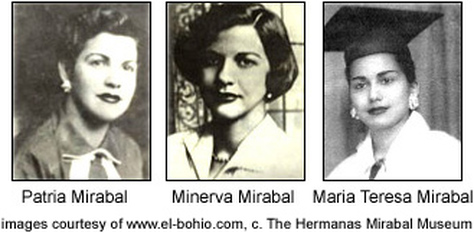
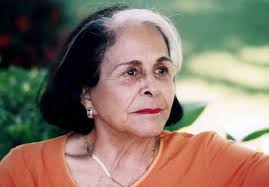
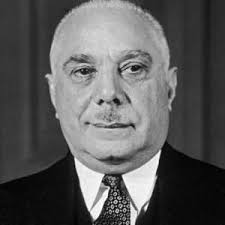
Rafael Trujillo was the dictator of the Dominican Republic from February 1930 until he was assassinated in 1961. He ruled the country with an iron fist. Rebel groups began to form in opposition of Trujillo. A group called the “Movement of the Fourteenth of June” emerged and was started by 3 of the four Mirabal sisters, Patria Mercedes Mirabal Reyes, María Argentina Minerva Mirabal Reyes, and Antonia María Teresa Mirabal Reyes.  They strongly opposed Trujillo’s regime and showed it by making weapons such as guns and bombs to use in a revolt against the government. They also passed out pamphlets and writings that went against the regime. In the book In the Time of the Butterflies by Julia Alvarez she tells the story of the Mirabal sisters also known as “Las Mariposas” (“The Butterflies”).  She tells their story from the point of view of the surviving Mirabal sister who did not join the rebel group, Dede Mirabal. 


7308852
“Las Mariposas” (“The Butterflies”)


unknown-2
Dede Mirabal


In the Person Sitting Next to You by Ross Snyder it says “Who is the person sitting next to you?  You might say a name, and describe how tall he is, and the color of his eyes and hair.  But none of these things are what the person is. A person is invisible activities” (Snyder 1).  This passage reminded me a lot of the Mirabal sisters.   Many people underestimated them. They are women, and it was in a time that many people believed  women were not capable of such revolutionary ideas. The Mirabal sisters were joined in their rebel group by many other people including their husbands.  Trujillo sent out direct orders for the Butterflies and their husbands arrests. He managed to only arrest two of them, Maria Teresa and Minerva, he also arrested all three of their husbands. “Then there had been the silence that always followed any compromising mention of the regime in public. One could never be sure who in a group might report what to the police. Every large household was said to have a servant on double payroll” (ITOB 94).  Trujillo’s tight rein over the Dominican Republic began to be noticed on a more international scale. The Organization of American States began investigating his treatment of the people and they went to the prisons to interview political prisoners. After The Organization of American States “condemned” the actions of Trujillo in 1960 and he released Maria Teresa and Minerva. Their husbands were still in jail at La Victoria Penitentiary in Santo Domingo. The three Butterflies died on November 25th, 1960 on their way back from visiting their husbands in prison. Before leaving to visit their husbands before they died they were warned by many different people including their surviving sister to not travel all together. They were warned this because they were already a target for Trujillo but together, they were  a larger target. Trujillo sent his men to kill the sisters in an attempt to stop their impact on the country. Patria, Minerva, Maria Teresa, and their driver de la Cruz were killed and, dead, put back in their car and pushed over the side of a mountain road to look like an accident. It wasn’t until after Trujillo was assassinated that the government admitted that they were killed. In 1999 the United Nations General Assembly designated November 25th as the International Day for the Elimination of Violence against Women, in honor of the sisters.

unknown
Rafael Trujillo

This winter break I got the opportunity to go to the Dominican Republic. Unfortunately I did not get the chance to see the  Mirabal Sisters Home Museum  because it was a little to far away. I did although get to see around the beautiful country which would not have been possible without the Mirabal sisters and their fight to take down the dictatorship.  And in a strange turn of events, while staying in the DR, my family and I rented a beautiful modern home owned by (what we have come to believe) a descendant of Major General Antonio Imbert Barrera, former President if the DR and one if the men responsible for the assassination of Rafael Trujillo. Imbert was considered a national hero, and professed to be the one who fired the final shots, killing the corrupt dictator. The Dominican Republic is now no longer a dictatorship and although some parts are still unsafe to go to, it is a thriving tourist destination. 


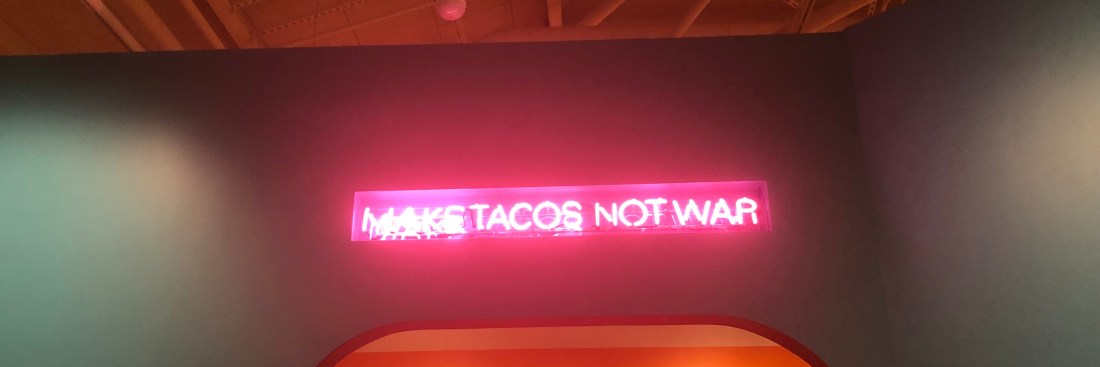
“Make Tacos Not War”


img_7508


For my second SAMO of the year, I went to the National Museum of Mexican Art on January 4th, 2019. I drove to the museum with my Mom and we were able to park on the street right outside the museum. I had never heard of the museum until I re-read the list of pre-approved SAMO places to go to. To me, it looked like one of the most interesting ones on the list. The museum itself is a red brick building and it’s not as big as many of the other museums in Chicago. Admission to the museum was free and all we had to do was sign in.  There were only a couple other people in the museum because it had just opened, so we had the whole place to ourselves! Instantly, I saw that all the art pieces had stories behind them and symbolized more than just pretty paintings.

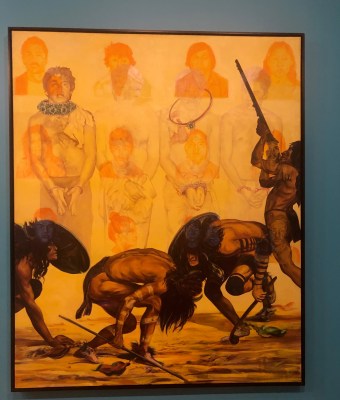
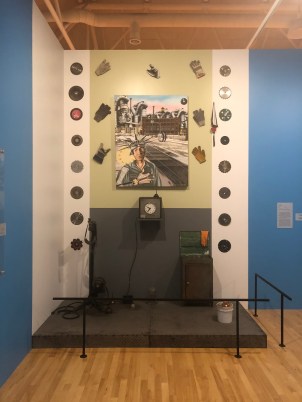
The painting “Savages and Glitter” by John Valadez, depicts the anti- immigration rhetoric in the United States. The term “glitter”in the title symbolizes the immigrants ideas of a better life. The painting shows how difficult and dangerous it is and what the immigrants face as they attempt to cross the border. Even though it was painted in 1986, it is still extremely relevant and powerful today.  “R.S.I” By Marcos Raya, also depicts the life of immigrants. Marcos Raya lived in Chicago in a time when most people worked in factories. R.S.I stands for repetitive stress injuries. These were the injuries often sustained by the factory workers. You can see in the painting the man’s hand seems to be made of machine parts. This is because the factories hired people and had them perform the same machine like motions every day.  These industrial workers also worked in dirty and unsafe work environments striving to reach the American dream.


savages and glitter
“Savages and Glitter” by John Valadez
img_7511
“R.S.I” By Marcos Raya. Symbolyzing the typical urban immigrant experience of working in industrial factories


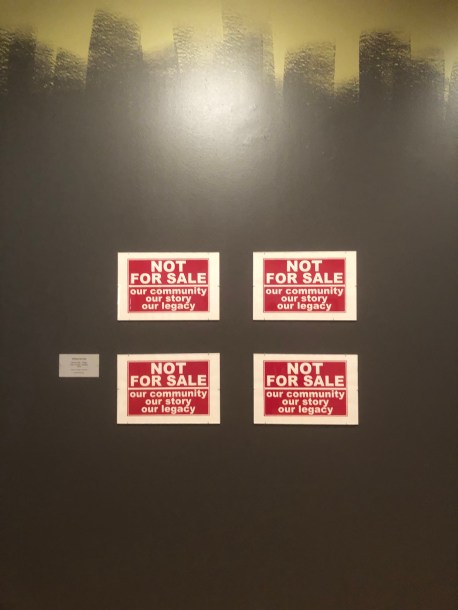
There was also a whole room of art pieces about the neighborhood in which the museum is located in. The museums neighborhood of Pilsen is predominantly Mexican. Culturally significant bright colors and murals painted on many of the homes in the neighborhood were a part of the reason Mexican people moved to Pilsen. The room also highlights the attempts of developers to gentrify the homes in the area. Painting them grey. The museum calls this color “gentrification grey” because it’s covering up the bright, colorful history of the neighborhood.   This reminded me of a quote in the Cycle of Socialization by Bobby Harro that says “What can I do to change it? It is a huge phenomenon, and my small efforts won’t count for much.’ Many of us choose to do nothing because it is (for a while) easier… besides it’s frightening to try and interrupt something so large” (Harro 3).

img_7514
You can see the wall behind the signs is almost fully painted “gentrification grey”

Even though it may seem like nothing can be done to prevent the washing out of all the bright colors, the museum has a whole room dedicated to highlighting what is going on in the neighborhood.  These artists featured are using their art to inform a wider audience about what they see happening. Even though the “revamping” of the neighborhood seems like something that can’t be altered and the art pieces seem like a small response, they are not.  They start a conversation about if it is really right to lose all of the history that goes with the houses and neighborhood. Going to the National Museum of Mexican Art was a new and exciting experience for me. I’m grateful that instead of sleeping in I made the short drive to the city to visit the museum. I learned not only more about the art there but also more about the fascinating Mexican heritage and the history of Chicago. 


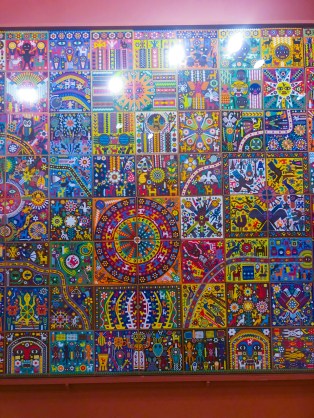
img_7527
“The New Awakening” By Santos Motoaopohua de la Torre de Santiago
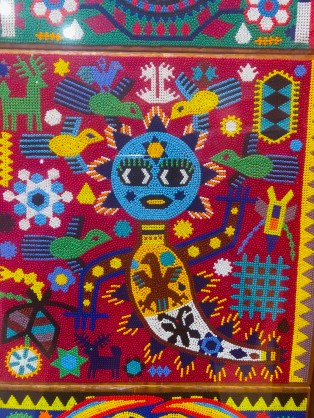
img_7528
Close up of “The New Awakening”. All done in chaquira beads


To Recap it all…

What: National Museum of Mexican Art

Where:   1852 W 19th St, Chicago, IL

How did you get there:  Drove with my Mom

How much did it cost? It was FREE!

Would you recommend it to other CST learners?  Yes! I learned a lot about Mexican Heritage that I didn’t know before and the art was beautiful.

Jiminy Cricket

How does someone develop their own conscience over time? How do you know what is the right and wrong thing to do? When I was younger I watched many different Disney movies like Pinocchio. In Pinocchio every time he lies his nose grows longer. Pinocchio’s conscience is named Jiminy Cricket and he guides Pinocchio into trying to become a real boy. In the movie there’s a quote that says “Always let your conscience be your guide.” At the time it went right over my head. Later in life I realized that my conscience is the voice in my head and if I ever don’t know what to do I should “let my conscience be my guide”.

download
Pinocchio’s nose grows longer when he lies

The voice in your head guides you through decisions you have to make. Whether you listen to the voice or not it’s your conscience is basically the more moral version of you.  Margaret Wheatley explains in Willing to be Disturbed  “Sometimes we hesitate to listen for differences because we don’t want to change. We’re comfortable with our lives and if we listened to anyone who raised questions, we’d have to get engaged in changing things” (Wheatley 2). Sometimes when we listen to our conscience we come to a realization that we may be heading or about to head down the wrong path, which can make us uncomfortable because we aren’t “willing to be disturbed”.  


Growing up I never viewed the voice in my head as a “voice in my head” or as my conscience. I just thought I could talk to myself and no one else could hear it. Anytime people would bring up the voice in their head telling them right from wrong I thought I didn’t have one. I didn’t realize until I was older that the voice is my head is my conscience and it talks to me all the time. Now I know that I use my conscience in every decision that I make. At Glenbrook North I’ve been in radio for almost 2 years now. When I first started it was really hard to learn how to work some of the computer programs and how to even complete an assignment correctly. Now that I’ve been in the class for longer I sometimes see the students who’ve been in the class for a shorter period of time then me  not understanding how to do the things I used to not understand. Even though I understand how to work those things now, instead of getting annoyed that they don’t know I try and help them with their projects and teach them how to do it in the future. I always try my best to help them because I remember what it was like when I didn’t know how to do those things also.

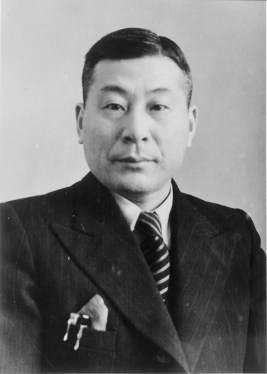
Acting out of good conscience is a no brainer for some people, like Chiune Sugihara. In The Japanese man who saved 6,000 Jews with his handwriting David Wolpe tells Chiunes brave story.


786627
Chiune Sugihara

During World War 2 Chiune Sugihara followed his conscience and did what he thought was right to save thousands of Jewish people fleeing occupied Poland. His bosses told him that, under no circumstance, could he be writing visas for them but after he thought about it he decided that was against his morals and he was going to do it anyway. “I told the minister of affairs it was a matter of humanity. I did not care if I lost my job. Anyone else would have done the same thing if they were in my place” (Wolpe). Chiune has  such a good conscience that he even tries to dismiss what he did by saying anyone would have done it, but not everyone has a strong enough conscience to guide them through something like that.

Not everyone can have a real life version of their conscience to talk to like Pinocchio. Sometimes we don’t know what’s the right thing to do and it can be hard to hear your conscience.  Sometimes the right thing to do can be confusing. That’s why you can discuss your decisions with other people and along with their advice and following your own conscience you can find your way.  “We weren’t trained to admit we don’t know” (Willing to be Disturbed). Talking through your ideas and seeking out advice when you don’t know something is not a bad thing. It’s a necessary thing to do to grow our conscience and realize that we can’t do everything alone in life, sometimes we  need a little help.

Don’t Stand Alone

I think about my social identity of being a Women the most in my life. I always wonder what would happen to me if I were to get stuck somewhere alone or if something else were to happen.  I think about this aspect of my life a lot because growing up my Mom always told me scary stories about people she knew when they were driving somewhere alone or walking alone. It has always made me afraid of needing help and being all alone. In Bobbie Harro’s text, The Cycle of Socialization it says “Our socialization begins before we are born, with no choice on our part. No one brings us a survey, in the womb, inquiring into which gender, class, religion we might want to be born into.” I was socialized growing up to think that if I was alone something bad could happen to me because I am a women, but never if I was I was surrounded by lots of people.  

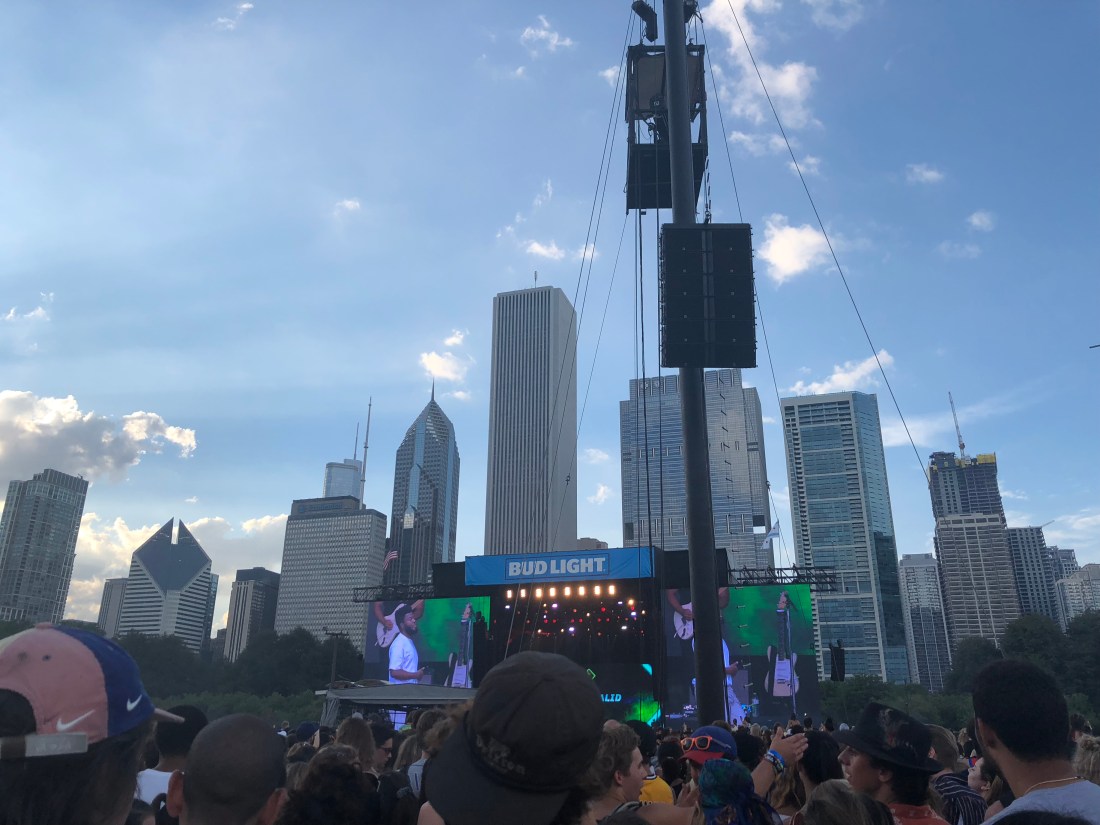
This summer I also thought a lot about this aspect of my identity when I went to Lollapalooza. In the concerts it is so packed everyone is squeezed tightly in. I was sometimes heads shorter than everyone around me and I couldn’t get any fresh air. I was constantly thinking about if I’d be able to breathe in the spot I was in or if a bigger person was going to fall on me.  On the second day of Lollapalooza me and my friend, Alexis, decided to wait for 3 hours so we could be front row at the rapper Lil Pump. It was the hottest day of the week but we were prepared with lots of water. I noticed we started to have less and less open space around us and the people filling in around us were all bigger than us. When the show finally started we could barely breathe and we were being jostled around in the crowd. . After the second song we couldn’t stay anymore and had to get pulled out of the crowd over the gate.  So many other people were passing out and had to get pulled out of the crowd they shut down his show. Walking away with my friends we were so shocked that what just happened, happened. We saw so many people needing to find help to get out and the people around them didn’t care enough to help them. I had never seen people see another person needing some space or needing help and not trying to help or moving away.

IMG_7133
How close I was to Lil Pump

After this experience I became very aware of how this identity affects my life. The following concerts I went to I stayed in the back so the same things wouldn’t happen again. I began to think more about how certain situations could hurt me or my easiest way out of something. In Margaret Wheatley’s Willing to be Disturbed it says “Noticing what surprises and disturbs me has been a very useful way to see invisible beliefs.”  I realized after this situation that I had been soacilized all my life to think that I am vulnerable if I were to be alone because no one is there to help me. After this experience I’ve seen that scary things can happen to you while surrounded by people who don’t even notice. I’m grateful for the experience and I have no regrets about it because it’s opened my eyes to see the effects in my life from the agent group I am apart of.  

IMG_6807
Staying more in the back of the crowds at Lollapalooza

SAMO 1
For my first SAMO experience of the year I went to the Museum of Contemporary Art on October 26th, 2018. It was a chilly fall day when me, my Mom and my sister Maeve, drove down to the city to visit the museum. Tickets to get in were free for me and Maeve because we are students under 18 while my mom’s ticket to get in was $15. There were a lot more people in the museum than I had anticipated but it wasn’t crowded.  Most of the people I saw at the museum looked like artists themselves and were very immersed in the artworks, I couldn’t really relate to that.  Walking around the museum I noticed some art pieces that I didn’t understand at all. I thought that was an interesting aspect of the museum because even though I saw something and didn’t understand it’s relevance, the same art piece could be extremely relevant to another person.


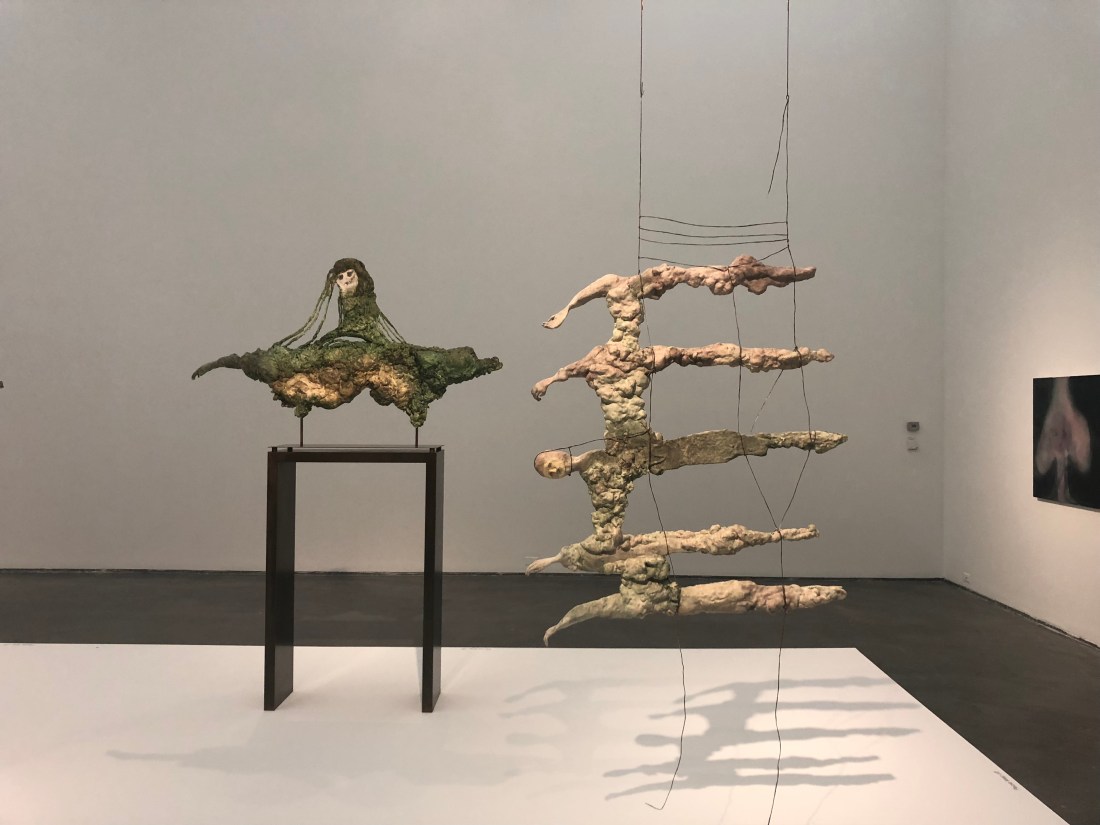
In “Willing to be Disturbed” by Margaret Wheatley she says “To be curious about how someone else interprets things, we have to be willing to admit we are not capable of figuring things out alone.” Walking through the museum I found myself not really understanding what some of the art was trying to portray. I found reading the artists descriptions of the art and the meaning can really make the art come alive. If you were to go the museum I would recommend always reading the artists descriptions because it gives insight into who the artist is and the background of the painting.  The description can also help you in figuring out the context of the painting and whether you see the same things or not.  One artist that was featured at the museum when I went was Enrico David.  When I first looked at his sculptures I didn’t understand them because I didn’t see anything in them I recognized. It was challenging for me to look at the sculpture and have completely no idea what it was supposed to be or the message behind it. After reading the description of the artworks I realized that I was looking at the sculptures expecting to see a cohesive outline begin to form. Instead I took a step back to look at the art all together and started to recognize things like a hand and a face.  I interpreted the sculptures to be a message about how things and people are not always what they seem to be and there is always more than meets the eye.

Enrico David
I had trouble understanding this art piece until I read the artist description. Artist: Enrico David


I don’t think I am exceptionally skilled in interpreting art because I do not visit museums that often and have little practice needing to do so. I think it’s important to be able to interpret art yourself even if you see something different than the artist intended. After visiting The Museum of Contemporary Art   I will definitely plan on visiting more museums like this one that challenges you to think outside of the box and makes you self reflect.


To Recap it all….

What:  Museum of Contemporary Art

Where:   220 E Chicago Ave, Chicago, IL

How did you get there:  Drove with my Mom and Sister

How much did it cost? $15

Would you recommend it to other CST learners?  Yes! It challenges you to think deeper than just accepting what’s on the surface.